

Women at Work: Surface Equality Masks Uneven Reality for Filipino Women
Updated: Jul 8

As Women’s Month draws attention to progress in gender equality, new nationwide data from Agile Data Solutions Inc. suggest that for many Filipino women, workplace fairness may be visible in principle but uneven in practice.
03 March 2026, Manila, Philippines — In many workplaces today, equality is no longer presented as an aspiration. Equal pay is expected, promotion systems are assumed to be fair, and inclusion has become part of the standard language of modern work. On the surface, this reflects real progress.
But new nationwide data from Agile Data Solutions Inc., gathered through Hustle PH, suggest that for many Filipino women, the experience of fairness remains less stable than the language surrounding it.
The study points to a condition in which fairness is visible in policy and widely recognized in perception, but not always consistently experienced in daily working life — what Agile Data Solutions Inc. identifies as Surface Equality. The findings capture that tension clearly. Even as many workplaces are seen as fair, a significant share of women report experiencing gaps in pay — reflecting this pattern of Surface Equality. Around 44 percent of women say they have been paid less than a colleague of another gender for similar work, highlighting the gap between how equality is presented and how it is lived.

At a time when workplace equality is often discussed as settled progress, the data suggest that for many women, the issue is no longer whether fairness is being promised, but whether it is being delivered reliably.
Fair systems, uneven outcomes
That same pattern appears in career advancement.
Among women surveyed, 62 percent believe promotions are awarded equally regardless of gender, yet about one in five say men are more likely to be promoted — another example of Surface Equality, where confidence in fair systems coexists with uneven outcomes.

At the same time, 41.72 percent of respondents report having been denied promotion despite being qualified, pointing to broader concerns about how opportunities are actually distributed.
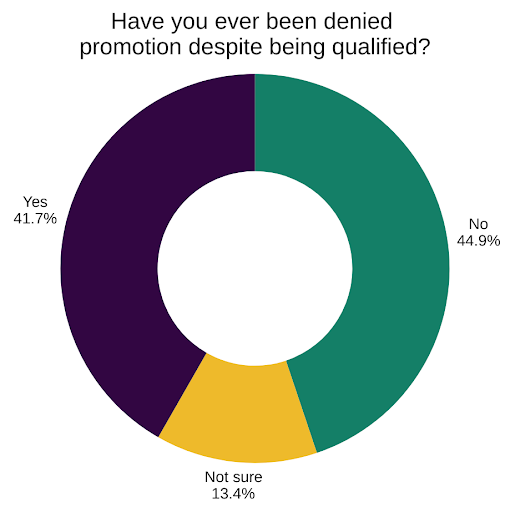
For women, this reflects a familiar challenge: fairness can appear intact at the system level while still breaking down in individual outcomes. Policies may look gender-neutral, but lived experience suggests that access to recognition and advancement is not always as equal as it seems.
Workplace culture and the weight of expectations
The findings also show that pay differences are not being understood by workers as purely technical or performance-based.
When asked what causes pay gaps, respondents most often cited experience gaps (55.31 percent), but a significant share pointed to gender bias or discrimination (41.05 percent) and cultural expectations (31.29 percent).

While these factors apply across the workforce, they are particularly relevant to women’s experience. Cultural expectations and gender bias often shape how competence, leadership, and assertiveness are interpreted — areas where women may be evaluated differently despite similar qualifications.
These less visible influences reflect how Surface Equality can persist even when formal structures appear fair, as everyday interactions and expectations continue to shape how women experience the workplace.
Negotiation and confidence gaps
The study further highlights how workplace culture affects women’s economic outcomes through salary negotiation.
More than half of respondents say they have hesitated to negotiate their salary. Among women, that figure rises to 61 percent, compared with 42 percent of men.

Respondents cited lack of confidence, fear of rejection, and the belief that company pay structures are fixed.
These are often framed as personal barriers, but the data suggest a more layered reality: even when negotiation is formally possible, it may not feel equally available to everyone.
For many women, this reflects another dimension of Surface Equality — where the opportunity to negotiate exists in principle, but does not feel equally accessible in practice.
Career paths shaped over time
The long-term picture is equally important.
A majority of respondents — 56.58 percent — believe that motherhood or family responsibilities affect women’s career growth.

This points to one of the most persistent dimensions of workplace inequality: the way women’s professional trajectories can be shaped by assumptions around caregiving, availability, and long-term commitment.
In this context, Surface Equality may exist at the level of policy, but structural expectations continue to influence how women’s careers progress over time.
Early gaps, lasting impact
The respondent profile gives added weight to these patterns.
The survey largely reflects the experiences of younger Filipino workers, with 38.65 percent aged 25 to 34 and 29.36 percent aged 18 to 24.
Income levels highlight the realities of early-career work. Nearly half of women surveyed — 47 percent — fall within the lowest income bracket (below ₱15,000), compared to 41 percent of men.

These early disparities suggest that Surface Equality may mask gaps that begin at the start of women’s careers and widen over time.
From policy to consistency
For Jason Gaguan, Chairman and Co-Founder of Agile Data Solutions Inc., the findings reflect a shift in how workers evaluate fairness.
“Many organizations today have policies that promote fairness, but equality is not only about what is written — it is also about how these policies are experienced day to day,” Gaguan said.
As women become more aware of how fairness plays out in actual pay decisions, promotion outcomes, and day-to-day treatment, workplace equality is being judged less by intent and more by consistency.
What workers say needs to change
Respondents also pointed to what meaningful action could look like.
Salary transparency policies and equal pay audits were among the most commonly suggested solutions, alongside flexible work arrangements and stronger government regulation.

These responses suggest that workers are looking for more than broad commitments — they want systems that make fairness easier to verify, not just easier to claim.
A Women’s Month reflection
As Women’s Month continues to celebrate gains in gender equality, the study also underscores what remains unfinished.
The challenge facing workplaces is no longer simply whether equality can be articulated, but whether it can be sustained in ways women can actually feel.
In workplaces shaped by Surface Equality, fairness may appear established before it is fully dependable — masking the uneven reality that many Filipino women continue to experience.
For many Filipino women, the question is no longer whether fairness exists — but whether it can be depended on in everyday working life.
About Agile Data Solutions Inc.
Your agile partner in data-driven growth.
Agile Data Solutions Inc. is the country’s premier market research technology company. Partnered with GCash, it has the largest panel size in the Philippines, boasting more than 74 million customer data points to date.
Agile Data Solutions’ hyper-targeted customer modeling is powered by its data-gathering platform Hustle PH, which connects a network of over 1,600,000 respondents nationwide. Through advanced data collection and innovative data engineering, Agile Data Solutions Inc. has become the preferred data and market insights partner of numerous Fortune 500 companies, banks, telecommunications, and technology firms across Southeast Asia.
For more information, visit https://www.agiledatasolutions.tech/ or email agilepartners@hustle-ph.com.
Comments