

Filipinos Aren’t Generous at Christmas — They’re Afraid to Be Seen as Broke
Updated: Jul 8

Fresh survey findings from Agile Data Solutions Inc. suggest that Christmas gift-giving in the Philippines remains widely observed even as household budgets stay tight, with Filipinos adjusting how they give rather than stepping away from the tradition altogether.
05 January 2026, Manila, Philippines — For generations, Christmas in the Philippines has been framed as a season of abundance—overflowing tables, gift exchanges, and generosity that seems to defy hardship. But new survey data suggests a quieter, more uncomfortable reality behind Filipino holiday gifting today: many Filipinos continue to give not because they have more, but because they cannot afford not to.
Based on a nationwide holiday gifting survey conducted in 2025 by Agile Data Solutions Inc. using its consumer insights platform Hustle PH, the findings point to a form of generosity shaped less by surplus and more by social expectation—particularly among young, low-income Filipinos.
“What stands out is not how much people are spending, but how rarely they opt out,” said Jason Gaguan, co-founder of Agile Data Solutions Inc. “Even when budgets are tight, Christmas gift-giving remains something Filipinos feel they need to participate in.”
This is not about splurging—it’s about showing up, even in small ways.
A Young, Low-Income Christmas
The survey, which gathered responses from 6,149 Filipinos nationwide, paints a clear picture of who today’s Christmas gifters are. Three out of four respondents (75%) are between 18 and 34 years old, dominated by Gen Z and young millennials. Around 65% report earning ₱10,000 or below, placing most respondents firmly in the low to lower-middle income bracket.
Despite these constraints, Christmas spending remains resilient. Among respondents in the ₱5,000+ income bracket, around 46% say they plan to spend more than last year. Across all income groups, about 38% expect to spend about the same, while just over one in ten (around 13%) plan to cut back.

The contrast is striking: despite limited incomes, many still expect their holiday spending to hold steady—or even rise.
Giving as Social Survival
Dig deeper, and the generosity begins to look less like choice and more like obligation. Most respondents plan to buy gifts for three to ten people, largely within immediate family and close circles, even as budgets remain tight: 64% say their total Christmas gift budget is ₱1,000 or below, and over 90% intend to keep each gift below ₱1,000.

The chart makes one thing clear: Filipinos often spread even small budgets across several people. Among those setting aside just ₱500–₱1,000 for Christmas gifts, the biggest group (47%) still plans to buy for three to five people, the strongest 3–5 pattern across all budget brackets. As budgets grow, the instinct isn’t to buy fewer, “better” gifts for a smaller circle; instead, more people use the extra budget to include more recipients. In short, Christmas gifting looks less like splurging and more like making sure no one is left out—even if it means dividing a limited amount into smaller pieces.
“We’re seeing people adjust how they give, not whether they give,” Gaguan said. “Budgets are capped, but the list of people to buy for stays largely intact.”
These are not lavish gestures, but carefully calibrated ones. Budgets are capped, choices are practical, yet participation remains widespread. In a culture shaped by hiya (shame) and pakikisama (social harmony), gift-giving functions less as discretionary spending and more as social participation—something people scale down, but rarely abandon.
Practical Gifts, Practical Love
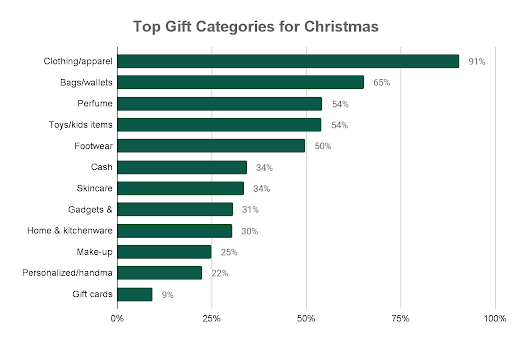
The types of gifts Filipinos plan to buy this Christmas reinforce the same theme: practicality under constraint. Clothing tops the list (91%), followed by bags and wallets (65%), while perfume and toys are tied at 54%—choices that are widely usable, affordable, and “safe” to give.
Even toys fit this practical pattern. For many households, children are non-negotiable recipients during the holidays, and toys or kids’ items are a reliable way to give something age-appropriate that will actually be used—without pushing budgets into luxury territory.
“The dominance of practical items tells us that gifting has become more about reliability than impressing,” Gaguan noted. “People are choosing gifts they know will be used.”
This is reflected in attitudes as well: 72% say they prioritize practical and useful gifts over branded or purely sentimental ones. It is not that emotion has disappeared from Christmas giving; it has simply been shaped by economics.
In today’s gifting culture, usefulness becomes its own kind of affection. A shirt, a wallet, a simple gadget—these are gifts that quietly say “naalala kita,” without demanding financial excess.
The Rise of Self-Gifting
Perhaps the most revealing insight is this: 38% of respondents plan to buy a gift for themselves this Christmas. In another context, self-gifting might be dismissed as indulgence.
But among a young, budget-constrained population, it reads less like vanity and more like emotional compensation—a small, controlled reward in a year marked by financial pressure.
The age split is telling. Among 18–24 year olds, 41% say they will buy themselves a gift, the highest “yes” rate across all age groups—suggesting that for younger Filipinos, self-gifting has become part of the holiday script. In contrast, 35–44 year olds are the most likely to say no, with 67% not planning to self-gift, the strongest “no” share across age brackets. The difference hints at a generational shift: younger adults appear more willing to claim a personal reward during the holidays, while older adults remain more anchored to traditional expectations of giving outward.

“Self-gifting among younger respondents isn’t about indulgence,” Gaguan said. “It looks more like a way to claim a small moment of reward in a season that’s otherwise focused on obligations.”
Self-gifts, however, are not extravagant. They tend to be practical and modest—basic clothing, everyday accessories, and small, budget-friendly gadgets such as earphones, phone accessories, and other low-cost tech add-ons. In a season defined by obligation, self-gifting becomes one of the few choices that feels personal: a way to participate in Christmas not only as a giver, but as someone who also deserves to receive.
Where Christmas Happens Now
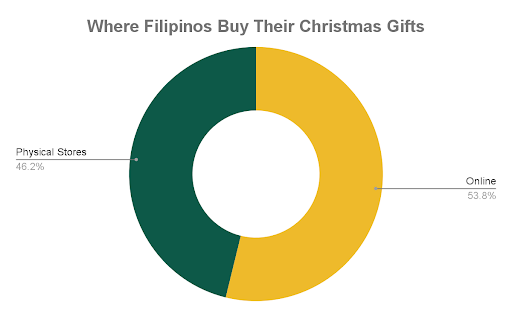
Shopping behavior also reflects this recalibration. While 53.8% now lean toward online shopping, offline retail still accounts for 46.2%, underscoring a hybrid Christmas economy.
Platforms like Shopee and TikTok Shop dominate online gift shopping, driven by lower prices, discounts, convenience, and social proof through reviews and live selling. At the same time, many still prefer physical stores to see product quality firsthand and avoid scams, delivery delays, or hidden costs.
Christmas, it seems, is no longer just a family ritual—it is also a platform-driven experience, shaped by algorithms, promos, and payday timing.
Not Less Generous—Just More Exposed
To say Filipinos “aren’t generous” at Christmas is not to accuse them of selfishness. Rather, it is to recognize how generosity itself has been reshaped by economic reality.
“Overall, the data shows a form of generosity that’s been reshaped by constraint,” Gaguan said. “It’s quieter, more practical, but still very much present.”
Today’s Christmas giving is smaller, quieter, and more strategic. It is generosity under surveillance—by family expectations, peer comparison, and social media visibility. The fear is not being ungenerous, but being seen as struggling.
And so, even when money is tight, Filipinos give anyway.
Not because they have more—but because opting out feels far more expensive.
About Agile Data Solutions Inc.
Your agile partner in data-driven growth.
Agile Data Solutions Inc. is the country’s premier market research technology company. Partnered with GCash, it has the largest panel size in the Philippines, boasting more than 74 million customer data points to date.
Agile Data Solutions’ hyper-targeted customer modeling is powered by its data-gathering platform Hustle PH, which connects a network of over 1,600,000 respondents nationwide. Through advanced data collection and innovative data engineering, Agile Data Solutions Inc. has become the preferred data and market insights partner of numerous Fortune 500 companies, banks, telecommunications, and technology firms across Southeast Asia.
For more information, visit https://www.agiledatasolutions.tech/ or email agilepartners@hustle-ph.com.
Comments